Slinky
|
Delay between frames = ms. dt = sec. Mass (m) = kg. Number of masses (n) = Drag mouse to zoom in and out. Click here for detailed analysis. |
The dynamics of a slinky is well-modeled by a string of \(\sf n \) small masses
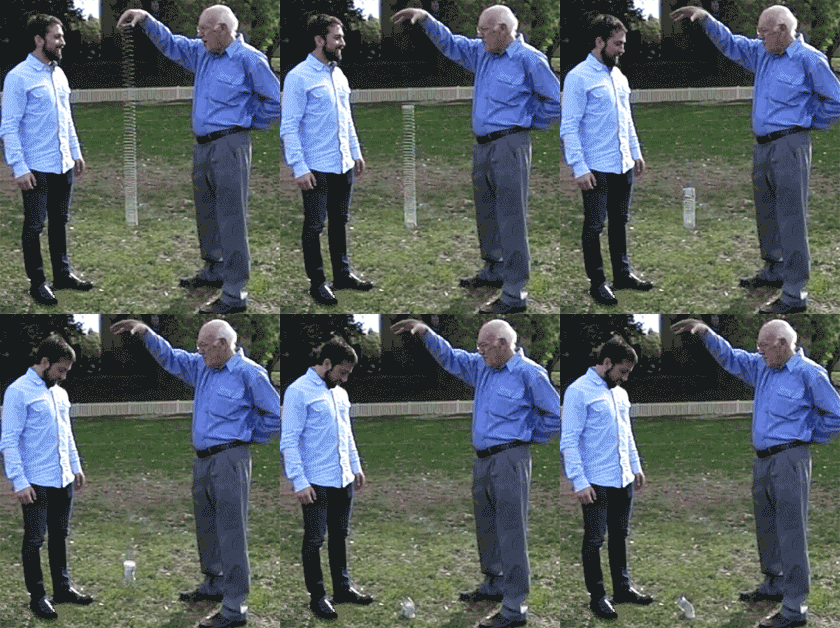
with adjacent masses attached to each other by springs. In the window is shown such a "slinky". Gravity is pulling it downward, but an invisible hand is holding the top mass to keep the whole thing from falling. Click the Let Go / Pause button to release the slinky and let it fall. If we assume that the masses are porous and can pass freely through each other, then the differential equation that describes the dynamics takes a simple form: \(\sf m \; \ddot{y} \; + \; k \; A \; y \; = \; -m \; g \; e. \) Here, \(\sf y \) denotes the vector containing the vertical coordinates of the \(\sf n \) masses, \(\sf m \) denotes the mass of each piece, \(\sf k \) denotes the spring constant, \(\sf g \) is the acceleration due to gravity, \(\sf e \) is a vector of all ones, and \(\sf A = \left[ \begin{array}{rrrrrrrrr} 1 & -1 \\ -1 & 2 & -1 \\ & -1 & 2 & -1 \\ & & \ddots & \ddots & \ddots \\ & & & -1 & 2 & -1 \\ & & & & -1 & 1 \end{array} \right] . \) The initial conditions are \(\sf y_j(0) = -\displaystyle \frac{mg}{k} \left( n j - \frac{1}{2} j (j+1) \right), \quad \dot{y}_j(0) = 0, \quad j = 0,1,\ldots,n-1 . \)
|


Updated 2015 Sep 20