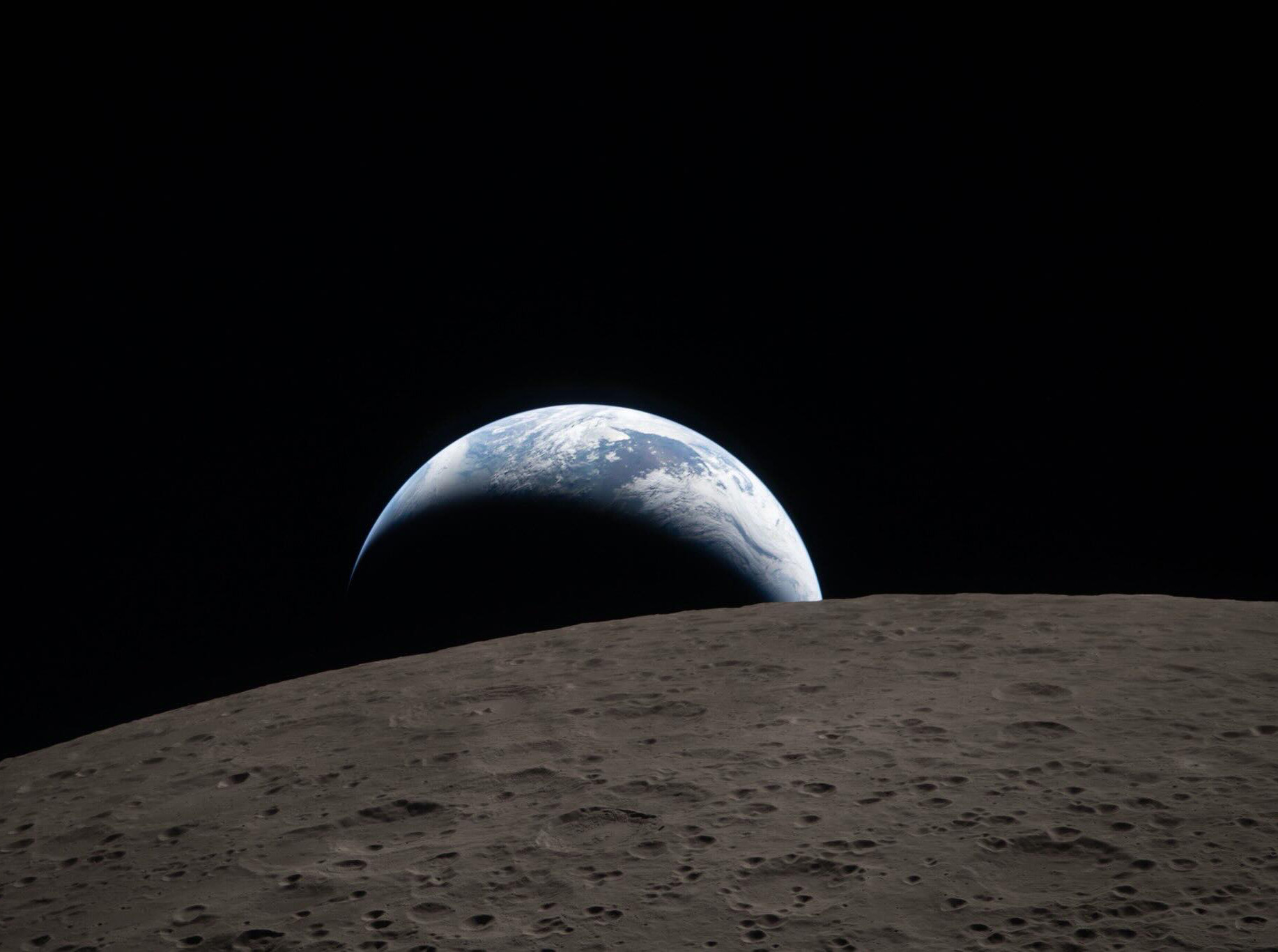
This picture was taken by an astronaut on the Artemis II Orion spacecraft as it was flying from Earth to the Moon and back. This picture was taken at about 6:40pm EDT on April 6, 2026, just before Orion passed behind the Moon.

An orrery is a mechanical model of the solar system. This is the Orrery that was made by David Rittenhouse and was bought by Princeton University in 1771 and installed in Nassau Hall. It is currently located just inside the main entrance into Peyton Hall which is the location of the Astrophysics Department.
This video shows orrery's for lots of star/planet systems discovered by the Kepler space telescope.

The Sun imaged with a narrowband H-alpha filter. Here we can see Sunspots and Solar Flares.

This is a picture of the Sun with Venus passing in front of it. Venus is the small round thing seen up by the upper left part of the Sun. It looks like it is on the Sun but in fact it is between us and the Sun. It's closer to us here on Earth than it is to the Sun. This Venus transit took place on June 5, 2012. The next Venus transit won't take place until December 10, 2117.

This picture of Jupiter was taken on Thanksgiving night, November 22, 2012. The moon on the right is Io. Jupiter is a planet that is much bigger than Earth and it is mostly made of gas. It is called a "gas giant". What we see are just clouds. The round looking patch in the lower right part of Jupiter is a storm. It is called the Great Red Spot. It's getting smaller and less dramatic as time goes by. But, it is bigger than Earth.
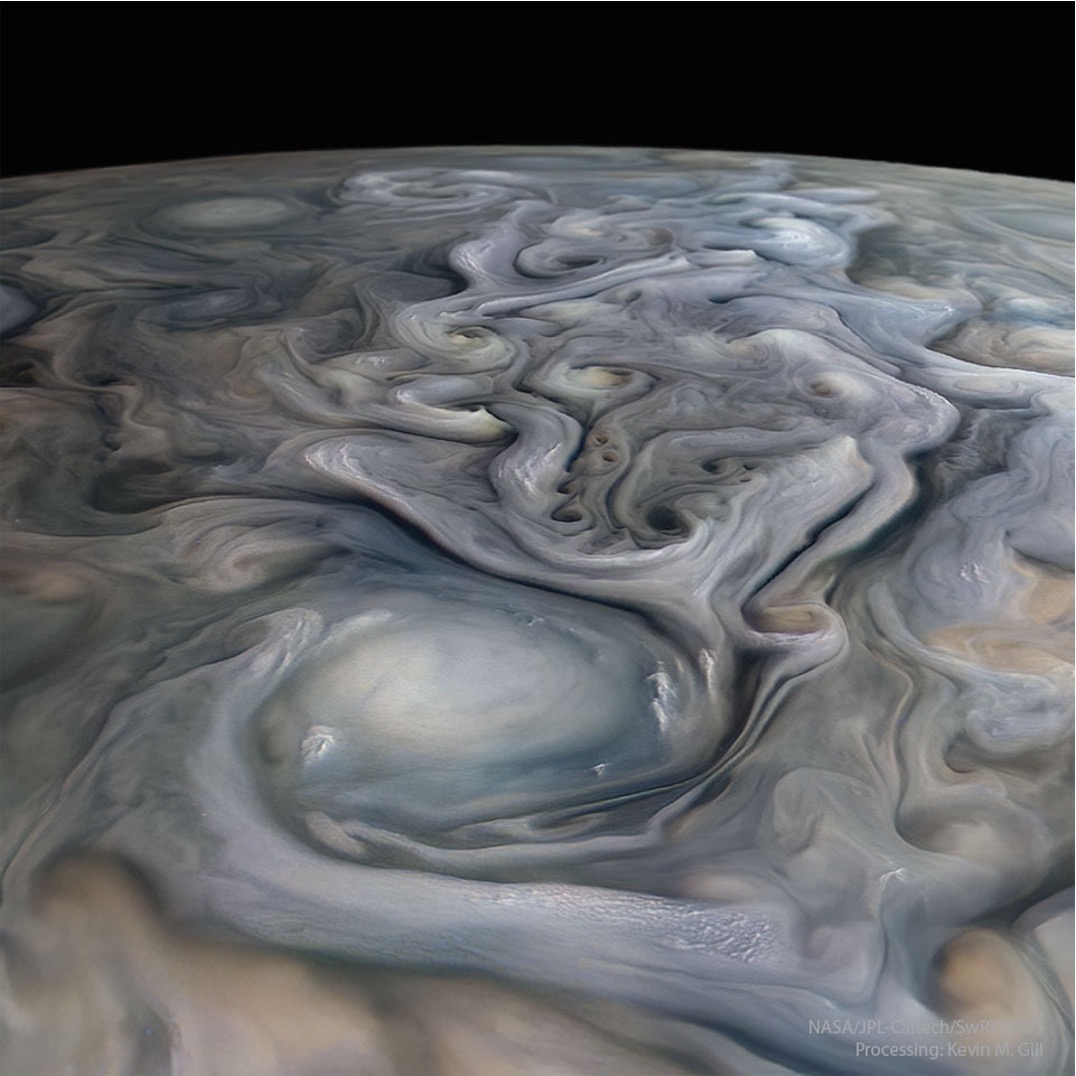
This is a close-up picture of Jupuiter's North Pole

This is NASA's Hubble Space Telescope's most recent (and best) picture of Saturn. Just like Jupiter, it is a gas giant (but not quite as big as Jupiter). But, even more interesting is that it has rings of dust orbiting over Saturn's equatorial region.

The Rosette Nebula is a cloud of atomic hydrogen (aka an H II region) located near one end of a giant molecular cloud in the Monoceros region of our Milky Way Galaxy. The cluster of bright stars are closely associated with the nebulosity, They have been formed from the nebula's hydrogen.

The Dumbbell Nebula, also known as M27, is a large planetary nebula located in the constellation Vulpecula. It's about 1,360 light years away from us.

The Orion Nebula, also known as M42, is a star-birth region in the constellation Orion where interstellar gas is in the process of condensing and forming new stars. It is one of the brightest deepsky nebulas visible to observers in the northern hemisphere. Visually, it is what appears to be the middle star of the three stars that make Orion's sword.

The Eagle Nebula (catalogued as M16) is a young open cluster of stars in the constellation Serpens. In the picture taken of it by the Hubble Space Telescope it is called the Pillars of Creation.
The Crab Nebula, also known as M1, is a supernova remnant. It's the leftovers from the supernova explosion that was seen in the year 1054 AD. At the center of the nebula lies the Crab Pulsar which is the neutron star remnant of the exploded supernova. Shown here are two pictures of the Crab Nebula taken 12.5 years apart. The smaller one if the older one.

The Veil Nebula is a huge gaseous remnant of a supernova explosion that took place some 5,000 to 8,000 years ago. The full nebula is approximately circular in shape and spans about 3 degrees on the sky.

The great globular cluster in Hercules, also known as M13, is the brightest and prettiest globular cluster visible to observers in the northern hemisphere. It's nearby to our Milky Way galaxy but it's not actually in our galaxy. It is however gravitationally attracted to our galaxy.

The Andromeda Galaxy, also known as M31, is the nearest major galaxy to our own Milky Way---only 2.5 million lightyears away. It is the largest galaxy in the so-called Local Group.
The Whirlpool Galaxy, also known as M51, is actually a pair of interacting galaxies about 23 million lightyears away from us. There have been two distinct supernova explosions in the Whirlpool in recent years.